

Native, Hybrid, or Cross-Platform: Which Mobile App Approach is Right for Retail?
13 April, 2026
When a retailer decides to invest in a mobile app, one of the first and most consequential decisions they face is a technical one: how should the app be built? The answer shapes everything from the quality of the customer experience to long-term commercial performance. Yet for many retail businesses, the distinctions between native, hybrid, and cross-platform development remain unclear.
This guide cuts through the jargon and explains what each approach means, what it delivers, and why the choice matters more than most retailers expect.
Understanding the Three Approaches
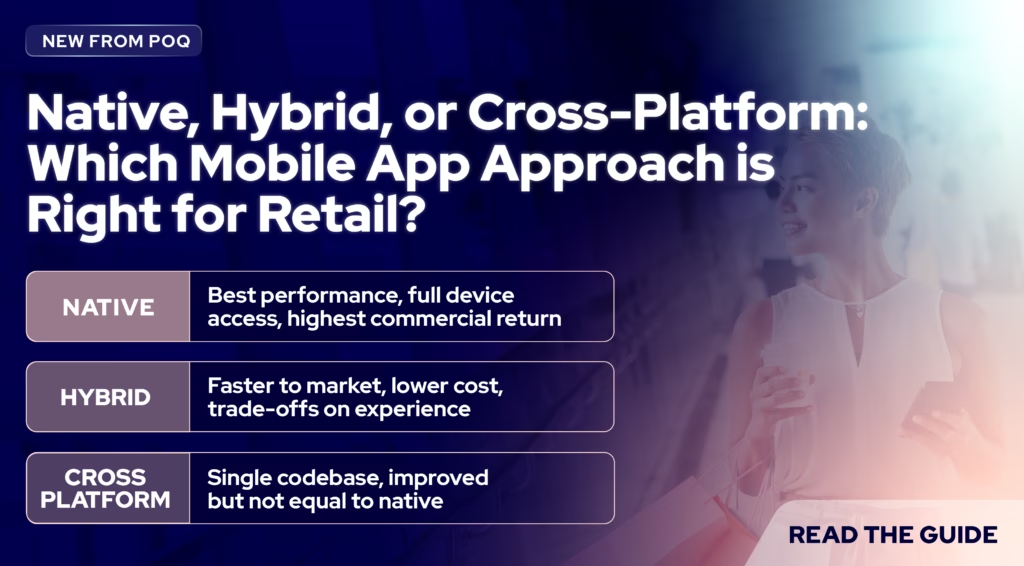
Native apps are built specifically for a single platform using that platform’s own programming language. iOS apps are written in Swift or Objective-C; Android apps in Kotlin or Java. This means the app is designed from the ground up to work with the operating system, the device hardware, and the conventions of that platform.
Hybrid apps take a different approach. At their core, they are web applications built with HTML, CSS, and JavaScript, packaged inside a native container so they can be listed in an app store. The app essentially runs a web browser in the background. Users may not notice the difference at first glance, but the experience often betrays itself in subtle ways: slower load times, less fluid animations, and a feel that does not quite match the rest of the phone.
Cross-platform frameworks such as React Native, Flutter, and Xamarin sit somewhere in between. They allow developers to write a single codebase that compiles into apps for both iOS and Android. These tools have matured considerably in recent years and represent a genuine improvement over hybrid approaches, but they still involve trade-offs compared to building natively.
Performance: Where the Differences Show Up Most
Performance is often where the gap between app types becomes most visible to the end user. Native apps have direct access to device hardware and software. That means faster rendering, smoother scrolling, and more responsive interactions. In a retail context, where a shopper is browsing product images, filtering search results, and moving through a checkout flow, that fluency has a direct impact on whether they complete a purchase or abandon the session.
Hybrid apps introduce a webview layer between the code and the device, which adds latency. Complex animations and transitions can stutter. Cross-platform frameworks have reduced this gap, but in high-demand scenarios they can still fall short of what a native build delivers.
User Experience: The Shopper Feels the Difference
Shoppers who use mobile apps regularly develop an intuition for what a good app feels like. Native apps integrate seamlessly with the conventions of iOS and Android, from gesture controls to navigation patterns to typography. The experience feels cohesive because it is designed for the platform rather than adapted to fit it.
Hybrid apps can struggle with UI consistency and often fail to honour platform-specific gestures correctly. Cross-platform frameworks aim to unify the experience across devices, but the result can feel generic rather than purposeful. Customers who download a retail app expecting something distinctive can feel disappointed if what they find is essentially a repackaged website.
Device Capabilities: Unlocking What the Phone Can Do
Modern smartphones are sophisticated devices with cameras, location services, biometric authentication, augmented reality capabilities, and more. Native apps can access all of these features fully and reliably. That opens up genuinely differentiated experiences for retail: barcode scanning in-store, AR-powered virtual try-on, location-triggered notifications near a physical store, and persistent login.
Hybrid apps are constrained by what the webview and available plugins can support, which is a narrower set. Cross-platform frameworks have improved access to device features but often require additional native code to unlock full functionality, which partially defeats the efficiency argument for using them in the first place.
Speed to Market: The Most Common Argument for Hybrid
The strongest commercial case for hybrid or cross-platform development is speed. Because hybrid apps reuse existing web assets and cross-platform frameworks share a single codebase, both approaches can get an app into stores faster than building two separate native apps. However, when using a platform for native, that also speeds up the launch process significantly.
However, this advantage is most relevant for apps with a short intended lifespan, such as a campaign or pilot. For a permanent retail app that will serve customers for years and needs to evolve with the business, the calculus shifts. A faster launch that delivers a weaker experience, accumulates technical debt, and limits future capability is rarely the better long-term investment. Many retailers who launched hybrid apps in the early years of mobile commerce found themselves rebuilding sooner than expected.
Security and Compliance
Security is a non-negotiable consideration for any app handling customer data and payment information. Native apps benefit from the security architecture built into iOS and Android, which has been designed and tested by Apple and Google respectively. Hybrid apps inherit the vulnerabilities of the web frameworks they rely on. Cross-platform apps can achieve strong security but require careful management of the frameworks and their updates to maintain it.
The Commercial Impact of Getting It Right
The architectural decision is not just a technical one. It has a direct bearing on commercial outcomes. Research consistently shows that app users are among a retailer’s most valuable customers. Across poq’s 2025 customer network, app users convert at a rate 73% higher than mobile web on average and in North America, that figure sits at 66%. AOV is consistently higher, with app orders running up to 25% above mobile web, depending on the market.
They buy more frequently, spend more per transaction, and exhibit higher lifetime value than those who shop through a mobile browser. A native app is better positioned to nurture that behaviour because it delivers the experience quality that keeps customers coming back.
Persistent login enables first-party data collection and personalization which is increasingly important as third-party cookies disappear. Push notifications drive re-engagement at scale: Airship’s analysis of 63 million users across 1,500 apps found that shoppers who received a push notification in their first 90 days retained at nearly 3x the rate of those who received none.
Loyalty integrations that sit behind biometric login drive genuinely habitual use. None of these capabilities is exclusive to native apps, but they all work better when the underlying experience is fast, reliable, and genuinely app-like, rather than a web experience wearing a native costume.
Making the Decision
For retailers who are serious about mobile as a growth channel, native development remains the strongest foundation. The performance advantages, device integration, user experience quality, and long-term scalability are difficult to replicate through any other approach.
Hybrid and cross-platform solutions have their place. They may be appropriate for businesses testing the water, running short-term campaigns, or operating with limited development resources. But for enterprise retailers investing in a mobile app as a long-term commercial asset, the architecture matters. Choosing a faster or cheaper approach at the outset can mean paying more later, in rebuild costs, in lost performance, and in customer experience that simply does not measure up to what shoppers have come to expect.
The question to ask is not just which approach gets us live fastest, but which approach gives our customers the experience that keeps them coming back.




You may be interested in...

Poq is now a Shopify Certified Technology Partner

Poq takes Five Below Native, Giving Its Mobile-First Shoppers a Faster Way to Shop

Download the Peak Trading Best Practices & Retail App Marketing Handbook 2026
