

TikTok Shop is the acquisition. The app is the relationship.
Helen Slaven, Chief Revenue Officer, poq
July 2026
A practitioner’s view from 12 years and 100+ enterprise retail apps. TikTok Shop is the most talked-about retail channel of 2026 and the one most often cited as a reason to underinvest in native apps. The argument is upside down. Retailers winning on TikTok need their app strategy more, not less.
In our first piece we argued that the agentic shift is the strongest reason yet to invest in your app, not the reason to bench it. This is the companion argument.
The same retail leaders being asked “do we still need an app given AI agents?” are also being asked, more loudly and more recently, “do we still need an app given TikTok Shop?”
Both questions miss the same thing. They treat the app as a channel competing with other channels, when the app is doing a different job entirely. The agent is the new front door. TikTok Shop is the new viral storefront. Each of them is fundamentally an acquisition surface. The app is the relationship surface. Substituting one for the other is not a strategic choice. It is a category error.
TikTok Shop is a remarkable acquisition channel. It is also, by design, an extraordinarily poor retention channel. That distinction is the whole argument.
The TikTok Shop opportunity is real, and so is the question
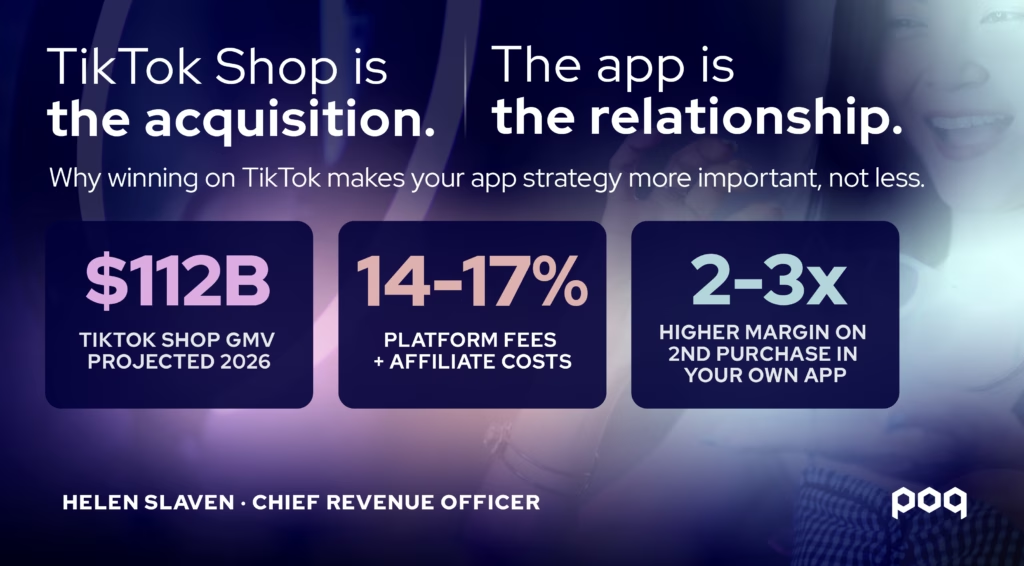
Let’s be honest about the scale. Global TikTok Shop GMV is on track for $112 billion in 2026, up from $64 billion in 2025. The US market is projected at $23 billion. Q1 2026 alone delivered $4.9 billion in US sales. Beauty and Personal Care leads the platform at $2.49 billion in GMV, more than 22% of the entire shop. Ralph Lauren, Ulta, Olaplex, Maybelline, e.l.f., Gap, PacSun, Tarte, and Crocs are all live, alongside 475,000 US merchants and 15 million globally. This is not an emerging trend. It is a top-five retail channel in several Western markets.
The question retailers are now asking is fair. If TikTok is delivering ten million dollars of GMV a month through creator-led discovery and shoppable feeds, and customers are completing the entire journey inside TikTok, do we still need an app at all? The customer never visits the website. They never download the app. They never sign in. They saw a video, tapped a product, and bought. Why invest in channels that come downstream of that?
It is a fair question. The right answer is not “of course you do.” The right answer is to look hard at the economic shape of what TikTok Shop actually is, and what it isn’t.
TikTok Shop is not what it looks like
From the GMV reports, it looks like a new front door for retail. What it actually is, when you trace the economics, is a high-volume customer acquisition machine with a structural retention hole built into the bottom of it.
Look at what a TikTok Shop customer actually arrives with. No email address. No phone number. No loyalty profile. No app installed. No account history with your brand. Their relationship with your product was mediated entirely by a creator who may or may not be the person they trust next time they shop the category. Their first impression of you was a fifteen-second video and a sub-one-minute checkout.
Now look at the unit economics. The average TikTok Shop seller plans for 14 to 17 per cent of revenue going to platform fees and affiliate commissions before any other cost. The platform’s culture is discount-heavy: most successful sellers offer 10 to 30 per cent off as a default expectation. Return rates on TikTok Shop run materially higher than on a brand’s own channels, particularly in beauty and apparel where impulse purchase meets sight-unseen sizing. And the platform takes a cut on every transaction, every time, with no end in sight.
TikTok Shop is a customer acquisition channel with the economics of an acquisition channel, not a relationship channel that happens to discount.
This is not a hidden truth. It is the channel functioning exactly as designed. TikTok Shop is built to convert impulse at scale, not to deepen relationships over time. The platform’s incentives are aligned with maximising frequency across the maximum number of brands, not with building any single brand’s customer base. Every dollar of GMV TikTok generates is also a dollar of customer time and attention flowing back to TikTok, not to the retailer.
The four asymmetries between TikTok and your app
The retention maths
The case for an app in a TikTok Shop world is, at its core, a maths problem. The numbers are approximate, but the shape holds across every brand we see.
Take a beauty brand with a $50 average order on TikTok Shop. After platform fees and discounts, net contribution is around $30 before product cost. Strip out cost of goods at a typical 25 per cent and contribution margin is closer to $17. Factor in returns and customer-service overhead and the first purchase often clears single-digit dollars or breaks even. The acquisition is a loss-leader by design. The channel only pays for itself if there is a second purchase.
If the second purchase happens back on TikTok, the same arithmetic repeats. The brand is running a perpetual customer acquisition machine that never quite reaches breakeven. If the second purchase happens in the brand’s app, contribution margin doubles or triples on the same order. From that point, every repeat purchase compounds: loyalty enrolment, push retention, in-store linkage, and lifetime value working in the retailer’s favour, not the platform’s.
The window is closing
Every successful platform that has reached this scale has eventually tried to capture the customer relationship outright. Amazon did it with Prime. Shopify did it with Shop Pay. Meta tried, and is trying again, with Shops. The pattern is consistent: once the platform has volume, it builds a loyalty programme that locks the customer into the platform’s ecosystem rather than the brand’s.
TikTok Shop has no native loyalty programme today. It is the obvious next move. When it lands, and it will, probably within an 18 to 36-month window, the customer’s allegiance starts shifting from your brand to TikTok’s platform. Cross-merchant points. Member-only pricing. Free or expedited shipping on platform-wide orders. Free returns inside the TikTok ecosystem. Once that exists, the customer’s reason to install your app gets weaker, not stronger. The acquisition you paid for stops being yours.
The retailers who build the bridge from TikTok to their app now will keep the customer for years. The ones who wait will find TikTok has built its own bridge first, and it doesn’t lead anywhere you own.
What this looks like in practice
The right strategy is not “TikTok or app.” It is “TikTok feeds the app.” In practice, that means four things.
What we believe
TikTok Shop is the most exciting customer acquisition channel of the last five years. Retailers who win on TikTok will reach customers they could not reach any other way. But TikTok Shop is structurally an acquisition channel, not a retention channel. Treating it as both is the most consequential strategic mistake a retailer can make in 2026.
The most successful TikTok Shop brands in 2028 will not be the ones with the biggest TikTok Shop revenue. They will be the ones with the highest TikTok-to-app conversion rate and the deepest app-based relationships with the customers TikTok introduced them to. That is not a guess. It is the same flywheel every successful direct-to-consumer brand has built over the last decade. And the flywheel only spins when the customer ends up somewhere the retailer actually owns.
TikTok Shop is the new acquisition. The app is, more than ever, the relationship. The retailers who treat them as two halves of one strategy will build compounding advantage. The ones who treat them as competing investments will find themselves running a customer acquisition machine that never quite reaches breakeven, and a customer relationship layer they no longer own.
We built our platform for the half of that strategy retailers own. The strongest retail brands of the next five years will be the ones who build the bridge between the new acquisition surfaces and their own relationship layer. The app is the relationship layer. It is the part that compounds. It is the part the platform cannot take away.
This is part two of a two-part series. Part one, “The Agent in the Room: Why agentic commerce will reward retailers with owned channels,” examines the rise of agentic AI and the evolving role of the native app in retail. Together the two pieces address the major forces reshaping retail acquisition strategy in 2026.
ABOUT POQ
Poq is the enterprise native app platform for retailers and brands. MACH, Salesforce, and Shopify certified. 100+ live apps across 170+ countries. €350M+ GMV processed annually. poq powers the mobile commerce strategies of global brands including Aeropostale, True Religion, E.L.F. Beauty, and Hotel Chocolat. We build the apps. We help our customers grow them.




You may be interested in...

Poq and Fast Simon Announce Partnership to Bring AI-Powered Search and Personalization to Native Mobile Commerce

Horze Native App Case Study

Poq Spring/Summer ’26 Release: Dynamic Content Everywhere, Speed and Autonomy for Your Team
