

Has Your App Strategy Surpassed Your Platform’s Capabilities?
How to recognize when your App platform has become a constraint instead of an enabler.
17 March, 2025
There’s a moment every digital leader experiences. Usually during a strategy meeting or quarterly planning session.
Someone suggests a feature that would genuinely move the business forward. The room gets excited. Then someone asks: “How long would this take to build in the App?”
The answer kills the momentum: “Six months. Maybe nine if we hit complications.”
That’s the moment you realize your App platform isn’t keeping pace with your business anymore.
It’s not dramatic. There’s no system failure or catastrophic bug. It’s quieter than that. Your App just can’t move at the speed your business needs to move. Your roadmap is full of ideas you can’t execute. Your competitors are shipping features you can’t match.
And the gap is widening.
If this sounds familiar, you’re not alone. Many brands, even with high App store ratings find their App strategy has outgrown their platform’s ability to deliver it.
Here’s how to recognize if you’ve hit that ceiling.
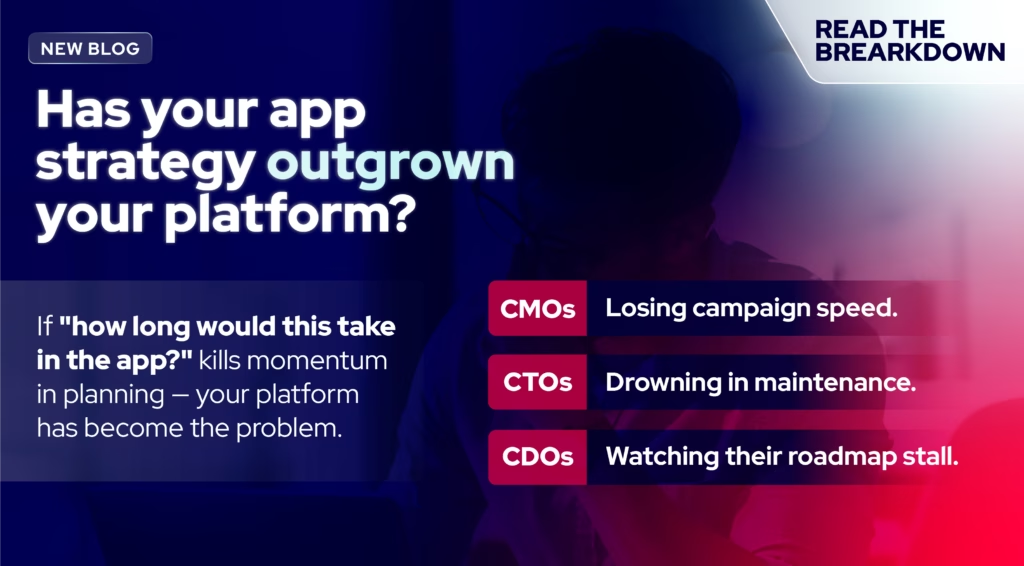
The CDO’s View: When Innovation Becomes a Waiting Game
The CTO’s View: When Maintenance Crowds Out Innovation
The CMO’s View: When Creativity Meets Platform Walls
The CDO’s View: When Innovation Becomes a Waiting Game
Pain Point 1: Your Innovation Backlog Is Growing, Not Shrinking
You have a 6 to 9 month feature backlog. Not because ideas are scarce, but because platform constraints mean every feature requires significant development effort.
Meanwhile, your web team ships updates weekly. They iterate, test, optimize. The App team? Still working on features that were approved two quarters ago.
The signal: Your digital roadmap consistently outpaces what your platform can actually deliver. You’re prioritizing based on platform limitations rather than business value.
Pain Point 2: Your App Experience Lags Behind Brand Evolution
Your brand team just completed a refresh. New design system, updated visual identity, modernized tone. It’s live on web, in stores, across all marketing.
Except in the App. Because implementing the new design system would require a near-complete rebuild. So your App represents a version of your brand that no longer exists everywhere else.
The signal: Your App feels dated not because it’s old, but because it can’t evolve at the same pace as the rest of your brand.
Pain Point 3: The Omnichannel Vision vs. Reality Gap
Buy online, pick up in store. Endless aisle. Virtual try-on. All the features that would genuinely bridge digital and physical retail.
They’re all stuck in the backlog. Not because you don’t see the value, but because your platform wasn’t built with these use cases in mind. Each one requires custom development that your team doesn’t have bandwidth for.
The signal: Your omnichannel strategy exists in PowerPoint presentations, not in customer experiences.
Pain Point 4: Data and Personalization Stop at the App Door
You’ve invested in first-party data infrastructure. CDP, analytics, segmentation tools. Personalization works beautifully on web.
But the App? It shows the same homepage to everyone. Same product recommendations. Same messaging. Because leveraging that data in the App requires development work you can’t prioritize.
The signal: Your personalization and data strategy has a blind spot the size of your highest-converting channel.
Is your app platform enabling your digital strategy — or quietly constraining it? Take the Platform Evaluation Quiz.
The CTO’s View: When Maintenance Crowds Out Innovation
Pain Point 1: Technical Debt Is Mounting Faster Than You Can Address It
Your App was built on a framework that made sense 3 to 5 years ago. It’s not broken. But it’s not modern either.
Maintenance costs are increasing. Every iOS or Android update requires extensive regression testing. Security patches take longer than they should. And the really frustrating part? You’re spending engineering resources just to stand still.
The signal: Increasing percentage of engineering time goes to maintenance rather than new development.
Pain Point 2: Vendor Lock-In Limits Your Architectural Freedom
You’re locked into your vendor’s roadmap. When they prioritize features you don’t need, you wait. When you need capabilities they haven’t built, you’re stuck.
You want to adopt composable commerce. Swap out components. Integrate best-of-breed tools. But your platform’s architecture doesn’t support it. You’re tied to their decisions, their timelines, their priorities.
The signal: Your technology choices are dictated by platform constraints rather than business requirements.
Pain Point 3: Your Engineering Team Is Trapped in Maintenance Mode
You have talented developers who want to work on interesting problems. Build new capabilities. Experiment with modern approaches.
Instead, they’re maintaining legacy code. Debugging integration issues. Working around platform limitations. And increasingly, they’re looking for roles where they can work with current technology.
The signal: Your best engineers are frustrated, and your recruiting pitch is weakening.
Pain Point 4: Every Integration Is Custom and Fragile
New martech tool? Custom integration required. Want to add a new payment provider? Months of development. Loyalty platform upgrade? Hope nothing breaks.
There are no pre-built connectors. No plugin ecosystem. Every integration is bespoke, time-consuming, and fragile. And when vendors release updates, you hold your breath hoping nothing breaks in your App.
The signal: You’re saying no to valuable technology partners because integration complexity outweighs the benefit.
Pain Point 5: Peak Traffic Makes You Nervous
Black Friday is approaching. You’ve run load tests. You’ve optimized what you can. But you’re still not confident the platform will handle the spike gracefully.
You can’t optimize further without significant rework. Performance visibility is limited. And scaling isn’t as simple as adding resources.
The signal: Peak seasons feel like survival tests rather than growth opportunities.
Technical debt, vendor lock-in, integration fragility. Find out where your platform really stands. Take the Platform Evaluation Quiz.
The CMO’s View: When Creativity Meets Platform Walls
Pain Point 1: Campaign Timelines Are Dictated by Development Capacity
Your team has a great campaign idea. Limited-time offer, shoppable content, interactive experience. Perfect for App users.
Then you learn it requires 3 to 6 months development time. By the time it launches, the moment has passed. The season is over. The relevance is gone.
So you scale back the idea. Or skip the App entirely. Your most engaged customers miss out because the platform can’t move at campaign speed.
The signal: You’re planning campaigns around platform constraints rather than market opportunities.
Pain Point 2: Content Updates Require Developer Involvement
You want to update hero imagery for a weekend sale. Swap featured products. Test a new merchandising layout.
On web, your team does this in minutes. In the App, it requires developer time. Or worse, it requires a new App store submission with a 24 to 48 hour review process.
The signal: Content that should be dynamic is effectively static because the platform makes updates too costly.
Pain Point 3: Your Loyalty Ambitions Are Platform-Limited
You have creative ideas for your loyalty program. Gamification, tiered rewards, personalized offers, exclusive experiences.
But your platform’s loyalty capabilities are basic. Points and discounts. The sophisticated program you envision requires development you can’t justify.
The signal: Your loyalty program is constrained by platform capabilities, not team creativity or customer interest.
Your app should be your highest-converting marketing channel. Find out if your platform is keeping up. Take the Platform Evaluation Quiz.
The Compounding Effect: How Platform Limitations Cascade
Here’s what makes this particularly insidious: these problems don’t exist in isolation. They compound.
The cycle looks like this:
- Platform can’t support new features quickly
- Development backlog grows
- Engineering team spends more time on maintenance
- Less capacity for innovation
- Marketing can’t execute campaigns
- Customer experience falls behind competitors
- App engagement and conversion suffer
- Executives question App ROI
- Investment in App strategy decreases
- Platform falls further behind
Meanwhile, your competitors who chose (or migrated to) modern platforms are shipping features, iterating quickly, and capturing market share.
What This Actually Costs You
Let’s be specific about what’s at stake.
Opportunity Cost
Every feature stuck in backlog represents revenue you’re not capturing. Every campaign you can’t execute is customer engagement you’re missing. Every optimization you can’t test is conversion lift you’re leaving on the table.
If your App users convert 41% higher than mobile web (industry average for native Apps), but you can’t optimize the App experience, you’re systematically underperforming your potential.
Competitive Position
Your competitors aren’t standing still. If they’re on modern platforms that enable rapid iteration, they’re testing, learning, and improving while you’re waiting for development capacity.
The gap compounds. What starts as “they launched a feature we’re planning” becomes “their entire App experience is superior to ours.”
Strategic Flexibility
Markets change. Customer expectations evolve. New technologies emerge. Your ability to respond depends on platform flexibility.
If every pivot requires 6 months of development, you can’t pivot. You can only watch change happen around you.
The Path Forward: What Modern Platforms Like Poq Enable
If you’re recognizing your organization in these pain points, the question becomes: what should you look for in a platform that actually keeps pace with business needs?
For CDOs: Speed and Flexibility
Modern platforms decouple content from code. Marketing teams can build experiences, test variations, and update content without developer involvement.
Features ship in weeks, not quarters. Brand updates apply across all touchpoints. Omnichannel capabilities are built in, not bolted on.
For CTOs: Modern Architecture and Ecosystem
Platforms built on current frameworks with composable architecture. Pre-built integrations with leading commerce, marketing, and data tools.
Engineering teams spend time on differentiation, not maintenance. You can adopt new technologies as they emerge rather than waiting for vendor roadmaps.
For CMOs: Creative Freedom
Campaigns execute at the speed of ideas. Content updates happen in real-time. A/B testing doesn’t require development cycles.
Loyalty programs are as sophisticated as your creativity allows. Personalization leverages all your first-party data.
For Everyone: Proven at Scale
Platforms that handle peak traffic gracefully. Infrastructure that gets faster under load, not slower. Performance visibility that enables optimization.
Most importantly: proof. Case studies from brands like yours. BFCM performance data. Actual results, not promises.
How to Evaluate If It’s Time for a Change
Not every platform challenge means you need to migrate. But if you’re experiencing multiple pain points across these areas, it’s worth evaluating your options.
We’ve created a Platform Evaluation Checklist to help you assess where you stand. It covers:
- Innovation velocity and backlog health
- Technical debt and maintenance burden
- Content management flexibility
- Integration capabilities and ecosystem
- Performance and scalability
- Team satisfaction and retention indicators
Take our platform evaluation test to see where your platform stands and what questions to ask if you’re evaluating alternatives.
The Real Question
The question isn’t whether your current platform is “bad.” It’s whether it can support where your business needs to go.
If your App strategy has surpassed your platform’s capabilities, that’s not a failure. It’s growth. Your ambitions have outpaced your tools.
The failure would be recognizing that gap and doing nothing about it.
Ready to evaluate your platform? Take our platform evaluation test and see where you stand. Or talk to our team about what’s possible when your platform keeps pace with your strategy.




You may be interested in...

Poq Integrates Talon.One to Power In-App Loyalty and Promotions for Retailers

Are Native Apps the Safest Channel for Digital Commerce?

The Download Barrier Is Dead: How App Clips Turn “Maybe Later” Into “Right Now”
