

The Agent in the Room: Why agentic commerce will reward retailers with owned channels
Helen Slaven, Chief Revenue Officer, poq
June 2026
The pattern is familiar. The stakes are higher.
Every few years, a powerful platform promises to transform shopping. Google tried it inside search. Meta tried it inside the social feed. Now AI is trying it inside the chatbot. OpenAI recently stepped back from direct in-chat checkouts, routing purchases through retailer apps like Target and Instacart instead. The handful of merchants that had gone live out of Shopify’s millions tells you everything about how difficult final-stage checkout integrations actually are.
The cycle is consistent: mass hype and impressive demos, a handful of merchant logos, then a quiet scaling back when reality catches up with the pitch.
None of this means agentic AI will not matter to retail. It is likely to be transformational. But not necessarily in the way current headlines suggest, and certainly not in the timelines being described as “now or never.” The real question for retail leaders is not “when will agents take over shopping?” It is: when AI agents arrive in force, where will your brand be showing up?
The bigger risk is not moving too slowly on agentic AI. It is being in the wrong position when it lands.
Why shopping is harder to automate than it looks
The current wave of agentic commerce rests on a seductive assumption: that shopping is fundamentally an optimisation problem. Compare specifications, weigh reviews, find the best price, execute. If that were true, the models we have today would already be reshaping retail. They are extraordinary at comparison, synthesis, and reasoning across large datasets, all of which are typically scraped from publicly available sites imported into their LLM.
But most shopping is not an optimisation problem. A forty-item grocery basket is shaped by your life stage, how many people you are feeding, what guests are coming at the weekend, what you had for dinner yesterday, and your mood in the aisle or on the site. A fashion purchase is driven by how something makes you feel, what you saw someone wearing, a shift in identity, an article you read. No agent optimising for price and specifications is even asking the right questions.
The standardisation challenge compounds this. A single product category, say yoghurt, involves dozens of attributes that matter to different customers: fat content, sugar, organic, brand, size, flavour, pack size. Multiply that across hundreds of thousands of products and millions of merchants. Then add that no retailer will surrender control of the customer experience unless the distribution payoff is overwhelming. Nobody has yet made that case convincingly.
The point of understanding, not the point of purchase
Where agentic AI will have impact first is not at the point of purchase. It is at the point of understanding: helping a customer figure out what they actually need before any transaction takes place.
This is not a small distinction. A customer asking an AI assistant “what should I wear to a smart-casual summer wedding?” is not looking for a price comparison. They are looking for guidance that is contextually aware, personalised, and trustworthy.
The AI that helps them get there is not replacing the retailer. It is creating a path toward the retailer whose app, whose brand, whose product range is positioned to answer that need.
This is where the structural advantage of owned channels becomes critical. The retailers with direct, consented, rich relationships with their customers will be the ones whose products surface in those moments. The retailers renting attention through paid channels, without the data and engagement signals that come from a loyal app audience, will not.
The economics of owned vs rented attention
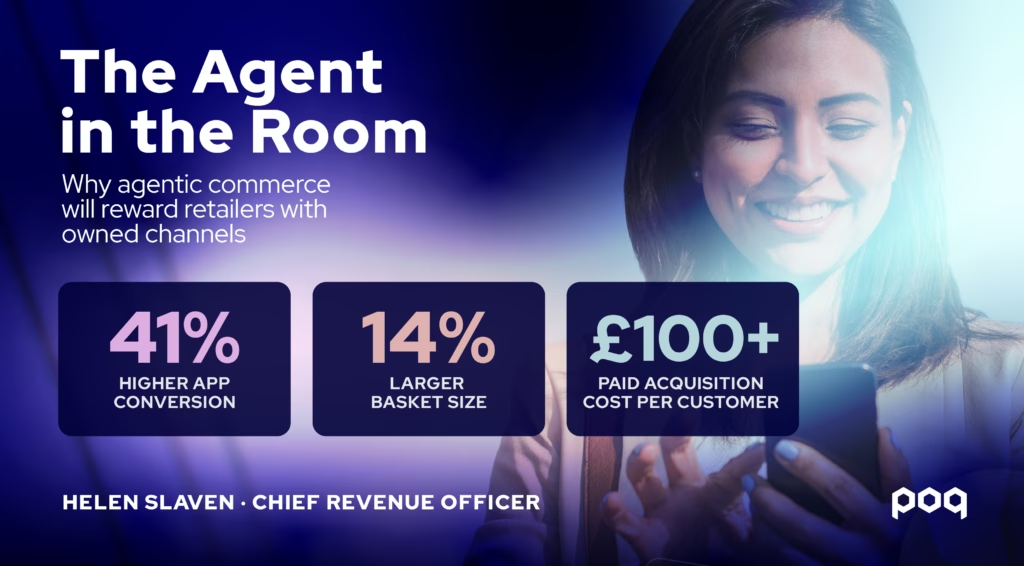
Customer acquisition costs via paid channels now average over £100 per customer and are rising year on year. Push notifications sent to an existing app audience cost fractions of a penny. App users convert at rates up to 41% higher than mobile web visitors and generate basket sizes 14% larger on average. The economics of owned engagement build over time. Paid attention has to be rebought with every campaign.
The disintermediation risk is real
Here is the risk that is not being talked about enough in retail boardrooms: if AI agents become a significant layer between intent and purchase, brands without strong direct channels will be at the mercy of whoever controls that layer.
This is not a hypothetical. It is the same structural dynamic that changed retail when Amazon aggregated product discovery, when Google owned the search intent moment, and when Meta owned the social influence moment. Each time, brands that had invested in direct customer relationships were better positioned to stay visible. Each time, brands that had not found themselves competing on someone else’s terms, paying for access to customers they had never really owned.
Agentic AI will create a new version of this dynamic. Agents will surface products and brands based on signals they have access to: reviews, pricing data, publicly available information. But the richest signal of all is genuine purchase intent from a loyal, engaged customer, which lives inside owned channels.
The richest signal of all? Genuine purchase intent from a loyal customer that lives inside the app.
What retailers should actually be doing now
The most important thing retailers can do in response to the agentic AI moment is not to chase it. The handful of brands that have rushed integrations with AI shopping interfaces have largely found the experience underwhelming for customers and operationally complex for themselves.
Instead, the strategic response is to own more of the customer relationship before the agents arrive in force. That means:
- Deepening direct channels, particularly native apps, which give retailers push access, rich behavioural data, and a persistent, branded presence on the device customers reach for first.
- Investing in zero-party and first-party data: knowing your customers well enough that any AI-assisted recommendation layer is working with your data, not guessing around its absence.
- Building the infrastructure for personalisation. The brands that will benefit most from AI’s point-of-understanding moment are those that can deliver a relevant, personalised response when the customer arrives.
- Watching, not leaping. Monitor which AI commerce integrations are gaining genuine traction with customers, not just merchant sign-ups, and be ready to move decisively when evidence of real behaviour change emerges.
The parallel that matters
Standardised shipping containers were designed to move goods more cheaply. Their real impact was the reorganisation of global manufacturing, moving factories to Asia in ways nobody pitching containers had described. The technology created the conditions for change. The change itself took a different form than anyone anticipated.
Agentic AI in retail will follow a similar pattern. The early demonstrations, such as buy buttons in chat interfaces and AI-curated product lists, are not the transformation. They are the proof of concept that something is changing. The actual transformation will look different, emerge from unexpected directions, and reward those who have built the right structural position in advance.
Right now, that position is about owned customer relationships. It is about the data, the trust, and the direct access that comes from having customers choose to engage with your brand on their own device, in their own time, through your own channel. That is not a defensive position. It is the foundation from which whatever comes next becomes an advantage rather than a threat.
This white paper draws on publicly available research, market analysis, and poq platform performance data.